Bako Motors: Tunisia’s Solar-Powered EV Startup Redefining Micromobility
Bako Motors is a Tunisian electric vehicle startup redefining micromobility across Africa and the Middle East with solar-powered tricycles and compact EVs designed for last-mile logistics and urban transport. Their vehicles are not Chinese knockdown kits but indigenous builds tailored to regional needs.
Origins Rooted in Practical Innovation
Founded in Tunisia, Bako Motors emerged from a pragmatic vision — to create affordable, sustainable transport solutions for urban and peri-urban environments underserved by conventional EV infrastructure.
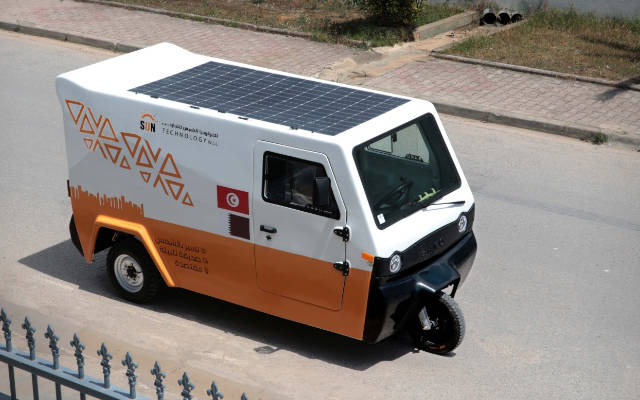
Their flagship model, the Bako B1, is a solar-assisted electric tricycle engineered for last-mile delivery. With a 2,000-liter cargo capacity and a rooftop solar panel generating up to 50 km of free driving per day, the B1 is optimized for regions where grid access is limited or unreliable.
This makes it especially attractive to logistics firms and e-commerce platforms seeking low-emission alternatives for dense urban corridors and informal delivery networks.
Regional Expansion and Strategic Partnerships
The company’s presence at the 2025 Riyadh EV Auto Show marked a strategic pivot toward regional expansion. Bako Motors announced plans to establish operations in Saudi Arabia, Nigeria, and Qatar — markets aligned with its focus on scalable, clean mobility solutions.
In Saudi Arabia, Bako has already broken ground on a local manufacturing facility, signaling a shift from export-based sales to regional assembly and adaptation.
According to Ahmed Al-Ghamdi, Bako’s business development and manufacturing lead in the Kingdom, the company is tailoring its vehicle configurations to meet the operational needs of local businesses, including partnerships with Amazon and other delivery platforms.
Indigenous Design Over Imported Kits
Unlike many low-cost EV startups that rely on Chinese knockdown kits, Bako Motors is pursuing indigenous design and localized production.
Their vehicles are built on modular platforms adaptable for cargo, passenger, or utility use. While detailed supply chain disclosures remain limited, the company emphasizes cost efficiency and energy performance.
Al-Ghamdi claims the Bako B1 delivers up to 12 km per kilowatt-hour — an efficiency benchmark that outpaces traditional gasoline vehicles in urban stop-and-go conditions.
Technology, Performance, and Sustainability
Battery specifications have not been publicly detailed, but given the vehicle’s solar integration and modest range requirements, it’s likely that Bako uses lithium-ion packs optimized for short-range, low-speed duty cycles.
The focus is on durability, simplicity, and low maintenance — qualities essential for fleet operators in emerging markets.
Performance specs are modest by Western EV standards: the B1 prioritizes payload, maneuverability, and energy independence over speed.
Expanding the Lineup: Bee and B-Van
In addition to the B1 tricycle, Bako Motors offers two automobile-style EVs — the Bee and the B-Van.
The Bako Bee is a compact, solar-powered city car designed for personal transport. Available in trims such as the Bee Wave and Bee Horizons, it features a minimalist design, rooftop solar panels, and seating for two.
Pricing starts around 18,000 Tunisian dinars (≈ USD 5,800), making it one of the most affordable solar EVs on the market. Under optimal sunlight, the Bee can harvest enough energy to cover over half of its daily driving needs.
The Bako B-Van is a larger, four-wheeled cargo vehicle for commercial use. It offers up to 400 kg payload capacity and a range between 100–300 km, depending on battery and solar input. Its solar roof can contribute up to 50 km of driving per day, reducing grid dependency and cutting operating costs for fleet managers.
Both models are built on modular, locally designed platforms and manufactured in Tunisia, with R&D operations in France and a new production facility underway in Saudi Arabia.
Localized Manufacturing as a Strategic Advantage
Bako’s business model blends manufacturing with strategic localization. By establishing regional factories and adapting its vehicles to local market conditions, the company avoids the pitfalls of one-size-fits-all EV deployment.
Their approach is reminiscent of a new generation of African-led innovation — where practical engineering, affordability, and sustainability converge to shape the future of electric mobility across emerging markets.